REST staking API contracts
Design stable resources for networks, validators, positions, actions, events, and rewards.
Read guideDesign safer crypto staking, liquid staking, validator, delegation, and yield APIs with explicit lifecycle state, signing boundaries, protocol evidence, and production-grade recovery.
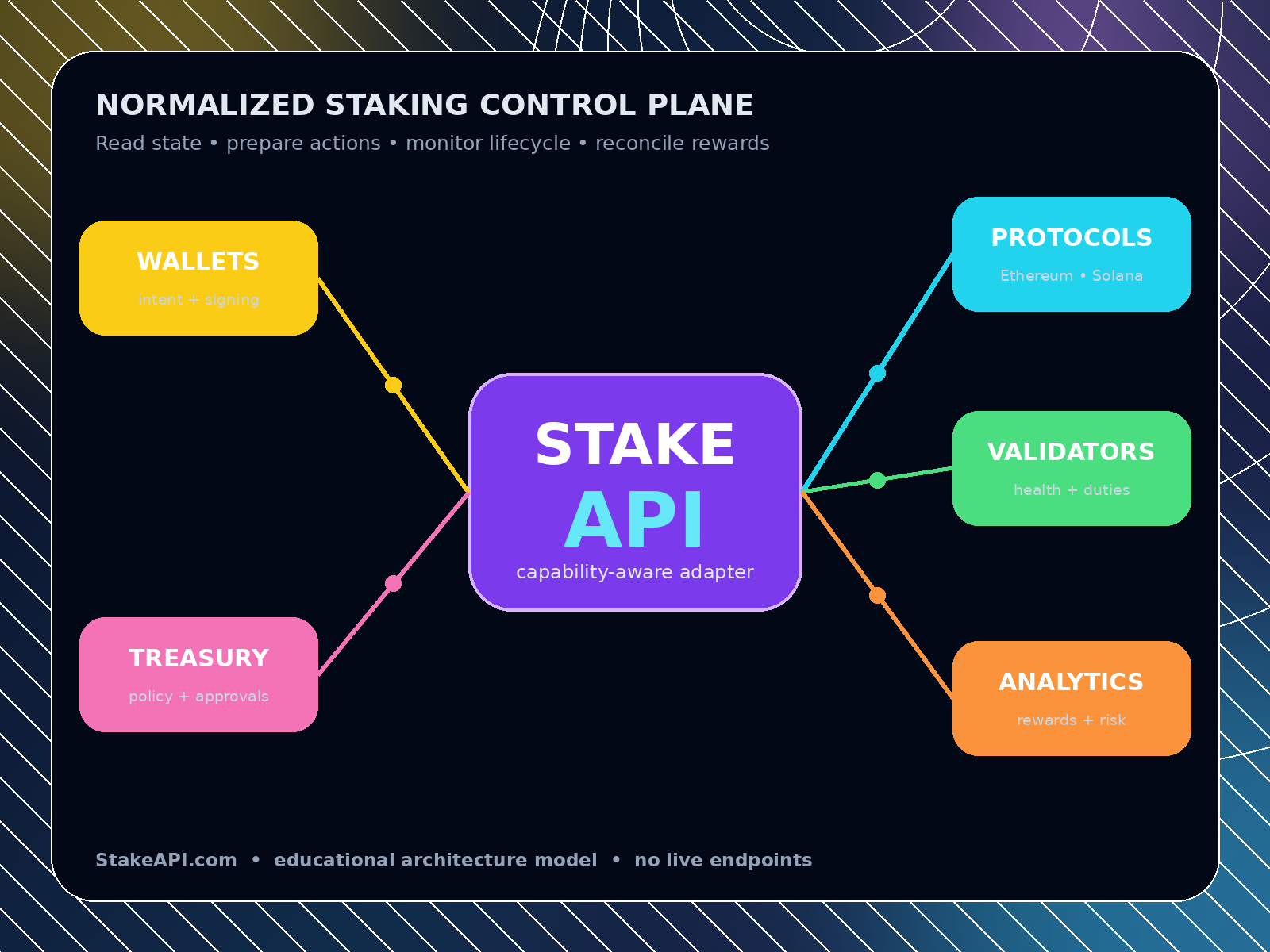
Use shared resources where semantics genuinely match, and preserve native data where networks differ.
Design stable resources for networks, validators, positions, actions, events, and rewards.
Read guideConnect deposits, consensus state, duties, exits, and withdrawals without collapsing layers.
Read guidePreserve stake accounts, authority roles, activation state, and account lineage.
Read guideModel token behavior, routes, contract metadata, accounting, and asynchronous claims.
Read guideExpose duties, telemetry freshness, incidents, signer health, and reconciliation.
Read guideBuild reproducible reward statements, APR and APY definitions, and cautious forecasts.
Read guidePreparation, signing, broadcast, activation, rewards, exit, and withdrawal can be separated by protocol time and external systems. Model each transition with status, timestamps, source evidence, and a safe recovery path.
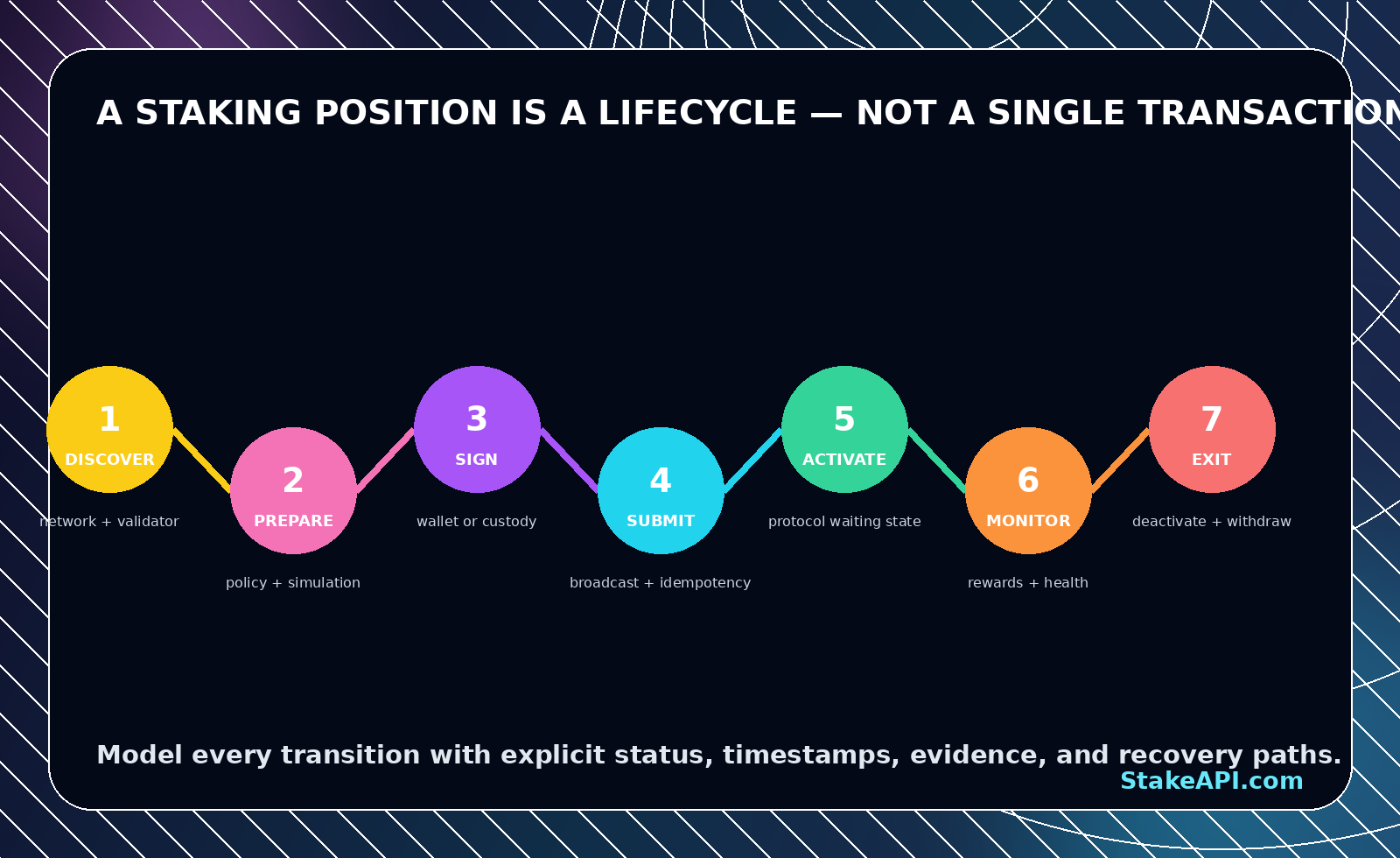
Keep user intent separate from unsigned preparation, wallet authorization, transaction submission, and observed protocol state.
The example is a design pattern only. StakeAPI.com does not host this endpoint.
Review fields and status codes{
"position_id": "pos_01J...",
"network": "ethereum-mainnet",
"native_state": "active_ongoing",
"status": "active",
"observed_at": "2026-10-23T20:15:00Z",
"evidence": {
"validator_pubkey": "0x...",
"source": "consensus-client",
"epoch": 412345
},
"next_actions": ["request_exit"]
}Long-form articles connect protocol mechanics to API resources, security boundaries, operations, and user experience.
A system-level guide to the resources, lifecycle states, signing boundaries, and reliability patterns behind a production staking API.
Read article
A safety blueprint for validator key custody, signing policy, slashing-protection data, migrations, distributed signers, and recovery drills.
Read article
A practical architecture for multi-chain staking automation using capability-aware adapters, durable workflows, idempotency, observability, and staged rollout.
Read articleNo. StakeAPI.com is an independent educational technical publication. It provides architecture guidance, examples, and a nonfunctional OpenAPI illustration, but it does not operate endpoints, custody assets, run validators for users, or promise staking returns.
It should return a durable workflow or action identifier, transaction evidence when available, current lifecycle state, observation time, data source, and the next condition being monitored. A broadcast response should not be mislabeled as protocol activation.
Use a small normalized core plus capability-aware, versioned protocol adapters. Preserve native state and identifiers so clients can understand why an action or lifecycle differs across networks.
Validator keys should remain in a dedicated signer, custody boundary, or hardware-backed environment with slashing protection. A general web API should request narrowly governed signing rather than store or export raw keys.
Usually not. APY is a derived metric that depends on a measurement window, compounding assumption, fees, penalties, position state, and methodology. A yield API should return those inputs and distinguish measured history from forecasts.
Start with the staking API architecture, then apply protocol, security, validator, and analytics guidance to your product.